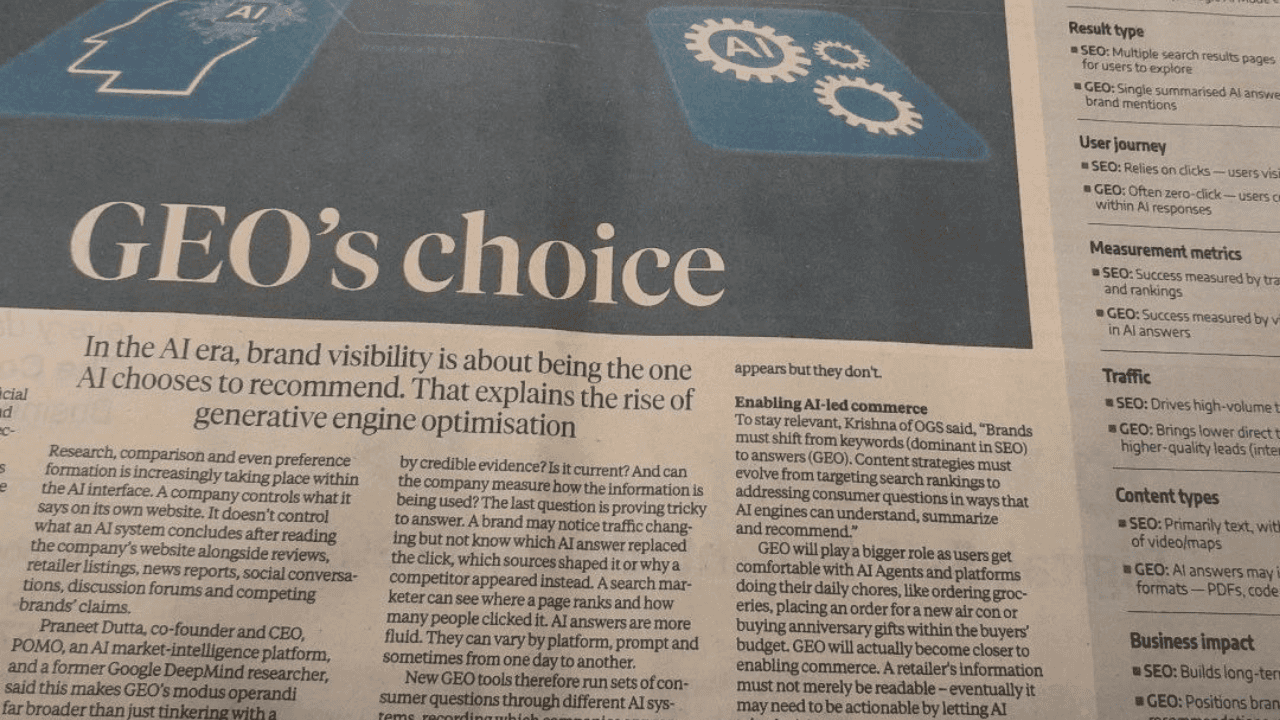
Generative Engine Optimization (GEO): Why AI Answer Engines Are the New Front Door for B2B Tech
For more than two decades, digital marketing across enterprise and software sectors operated on an uncomplicated premise: identify a high-volume target keyword, optimize on-page structure and backlink equity, rank on page one of Google, and drive organic traffic into conversion funnels.
While traditional search engine optimization (SEO) remains a fundamental layer of web infrastructure, the buyer journey has splintered. The emergence of conversational AI engines—including OpenAI’s SearchGPT, Perplexity AI, Google Gemini, and Anthropic’s Claude—has fundamentally changed how software evaluation and procurement decisions occur.
Prospective B2B decision-makers no longer sift through ten distinct blue links across multiple browser tabs. Instead, they input multi-layered prompts to evaluate architectures, compare compliance standards, and receive synthesized vendor recommendations directly inside an answer interface.
If your solution is not cited within that synthesized answer, you forfeit the prospect before they ever navigate to an official landing page.
| Strategic Dimension | Traditional SEO | Generative Engine Optimization (GEO) |
| Primary Objective | Rank pages for target keywords to capture direct clicks. | Establish the brand as the cited source and recommended authority in AI answers. |
| User Journey | Enter search term $\rightarrow$ Scan organic links $\rightarrow$ Visit site. | Enter prompt $\rightarrow$ LLM synthesizes web context $\rightarrow$ Direct answer/recommendation. |
| Core KPIs | Keyword rank position, organic click-through rate (CTR), page impressions. | AI Share of Voice (SoV), citation frequency, attribute sentiment in generated answers. |
| Content Strategy | High-density keyword matching, header tag optimization, and backlink volume. | Factual clarity, structured data, entity authority, and third-party web consensus. |
3 Foundational Pillars of an Intent-Driven GEO Strategy
Capturing visibility inside AI answer engines requires moving away from thin informational blogging toward authoritative, data-dense digital publishing:
1. External Ecosystem Consensus Outweighs On-Page Claims
Large language models do not accept proprietary website claims as absolute truth. When assessing whether a vendor is reliable, enterprise-grade, or secure, model crawlers ingest external sources:
Industry analysis and teardowns from third-party media outlets.
Unbiased comparison studies and implementation whitepapers.
Practitioner discussions across authoritative communities and forums.
If your marketing copy claims you are the leading platform in your niche but external technical coverage does not reflect that standing, AI models will synthesize the prevailing market consensus instead. Broadening your digital publishing footprint across credible third-party channels is essential.
2. Prompts Are Longer, Specific, and Context-Rich
Unlike legacy search engines where users search fragmented phrases such as “best b2b crm,” generative engine prompts are frequently three to five times longer. Buyers input contextual operational parameters:
“Compare lightweight B2B CRM solutions compatible with SOC-2 Type II standards that offer native Slack integrations for an enterprise team of under 100.”
Content that relies solely on high-level definitions will be bypassed by AI retrieval algorithms. Editorial publishing must address implementation trade-offs, integration hurdles, and explicit architectural limitations.
3. Semantic Structuring and Direct Answer Density
AI crawlers prioritize clear semantic information over prose filler. To ensure your digital assets are crawlable and easily extracted by Retrieval-Augmented Generation (RAG) pipelines:
Use clean Markdown tables to present feature comparisons and pricing structures.
Open sections with clear, declarative answers before elaborating on context.
Implement structured schema markup (Organization, Product, and Article schemas) to remove ambiguity regarding your brand’s core offerings.
Adapting Your Content Pipeline
Generative Engine Optimization does not mean abandoning traditional search best practices; rather, it elevates search marketing into true corporate publishing.
When your organization’s digital content solves explicit commercial-intent queries with verifiable technical accuracy, your brand secures both search engine page-one real estate and consistent citations inside next-generation AI platforms.
“By aligning editorial clarity with generative search architecture, enterprise brands safeguard their future pipeline. Ramviv Digital Media continues to monitor model index changes across Claude, Gemini, and ChatGPT to ensure maximum client authority and citation frequency.”
Ready to Secure Your Brand's Presence in Generative Answer Engines?
At Ramviv Digital Media, we structure, syndicate, and publish high-authority B2B assets that capture commercial search intent and ensure your products are cited across AI models.