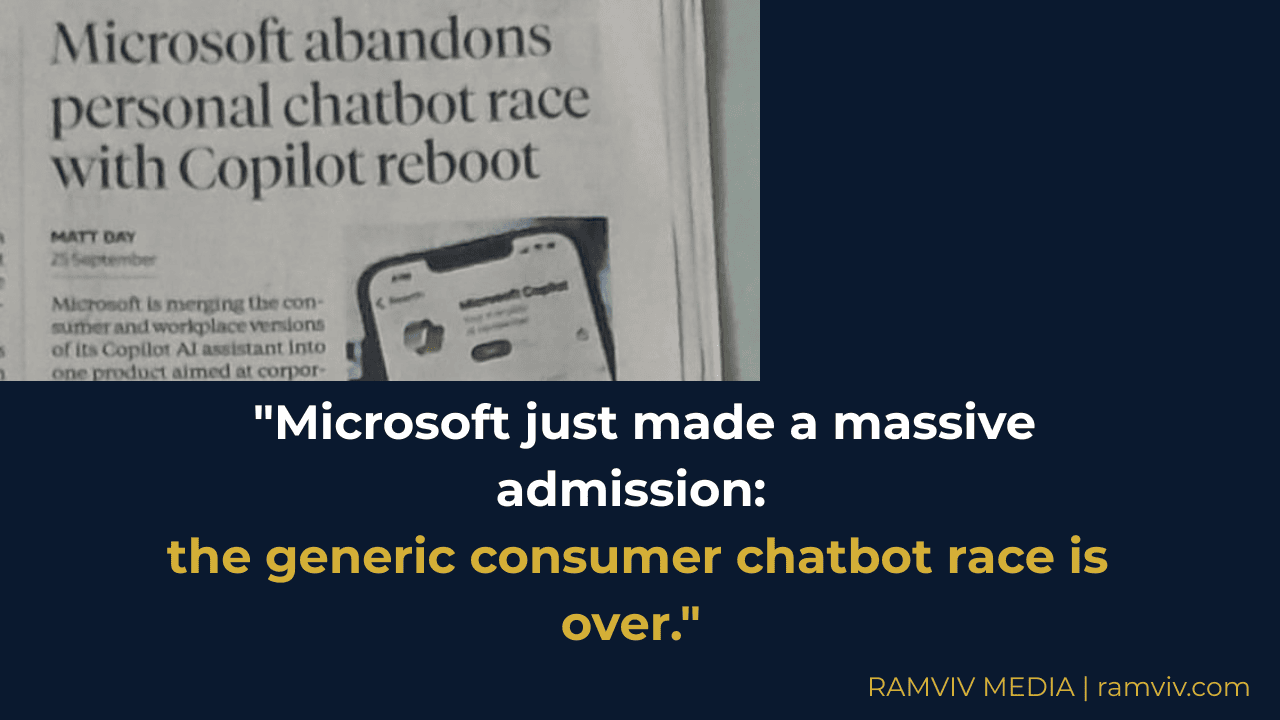
The Great Retraction: Why Microsoft Abandoned the Consumer Chatbot Race for Enterprise Workflows
When the generative AI race ignited, every major hyperscaler raced to deploy a consumer-facing conversational companion. Microsoft rebranded Bing, pushed Copilot onto consumer desktops, and bet heavily that individual users wanted an omnipresent personal chatbot.
In late September 2026, Microsoft quietly called time on that experiment.
As reported by Bloomberg, Microsoft has merged its consumer and workplace Copilot units into a singular, unified enterprise offering, formally ceding the consumer chatbot arena to players like OpenAI, Google, and Meta.
Instead of trying to win consumer mindshare as an everyday chat app, the re-engineered Copilot is refocusing strictly on corporate productivity: deep, native manipulation inside Excel and Word, embedded automation agents, and dashboard orchestration.
This strategic retreat signals a profound turning point in the software economy: the era of the detached chatbot is giving way to embedded, high-utility enterprise workflows.
1. The Death of the Standalone Prompt Box
The fundamental flaw of the early consumer AI cycle was the expectation that everyday users would build habits around an open prompt window.
While power users leverage frontier reasoning models, the vast majority of consumer chat interactions remained shallow, low-retention, and commercially unmonetizable. A chatbot answering questions quickly in isolation fails to provide ongoing economic value unless it is directly coupled to an outcome.
In enterprise environments, the friction was even more obvious:
* Workers did not want to copy-paste context from their spreadsheets into an external chatbot window.
* Standalone conversational bots lacked write-access to core document structures.
* The overhead of prompt drafting negated the time-saving promise of the model.
By rebuilding Copilot to execute directly within Word and Excel files, Microsoft is acknowledging reality: **software value is determined by the speed with which it manipulates the primary artifact, not how fluently it chats.
2. From Conversational novelty to Asynchronous Automation
The pivot from consumer assistant to workplace utility reflects three architectural shifts:
A. Deep Artifact Native Operations
AI interfaces are migrating directly into software surfaces. Rather than summarizing an uploaded file in an isolated sidebar, enterprise models must update formulas, modify database schemas, and refactor copy directly inside the live canvas.
B. Ambient, Always-On Agents
Corporate teams do not need another chatbot to prompt; they need asynchronous background workers that monitor data streams, triage anomalies, and automate repetitive tasks across the software stack without human intervention.
C. Hard RoI Over Generative Vanity
As enterprise IT budgets face rigorous scrutiny, CFOs are defunding discretionary “experimental” bots in favor of tools that measurably reduce operational overhead or accelerate customer transactions.
3. The Takeaway for B2B Discovery and Media Buying
The lessons from Microsoft’s Copilot reboot extend directly to how tech brands manage search visibility, content distribution, and customer acquisition.
Flooding digital ecosystems with generic AI conversational answers delivers zero long-term retention. Modern B2B buyers and decision-makers navigate via high-intent, authoritative data sources.
To win in the modern landscape, software platforms must optimize not for casual conversational volume, but for verified authority, generative search engine citations (GEO), and direct alignment with real commercial intent.
Position Your Platform for Real Commercial Discovery
At Ramviv Digital Media, we help B2B tech organizations move past vanity metrics to secure authoritative Generative Engine Optimization (GEO), content syndication, and high-converting commercial pipeline.