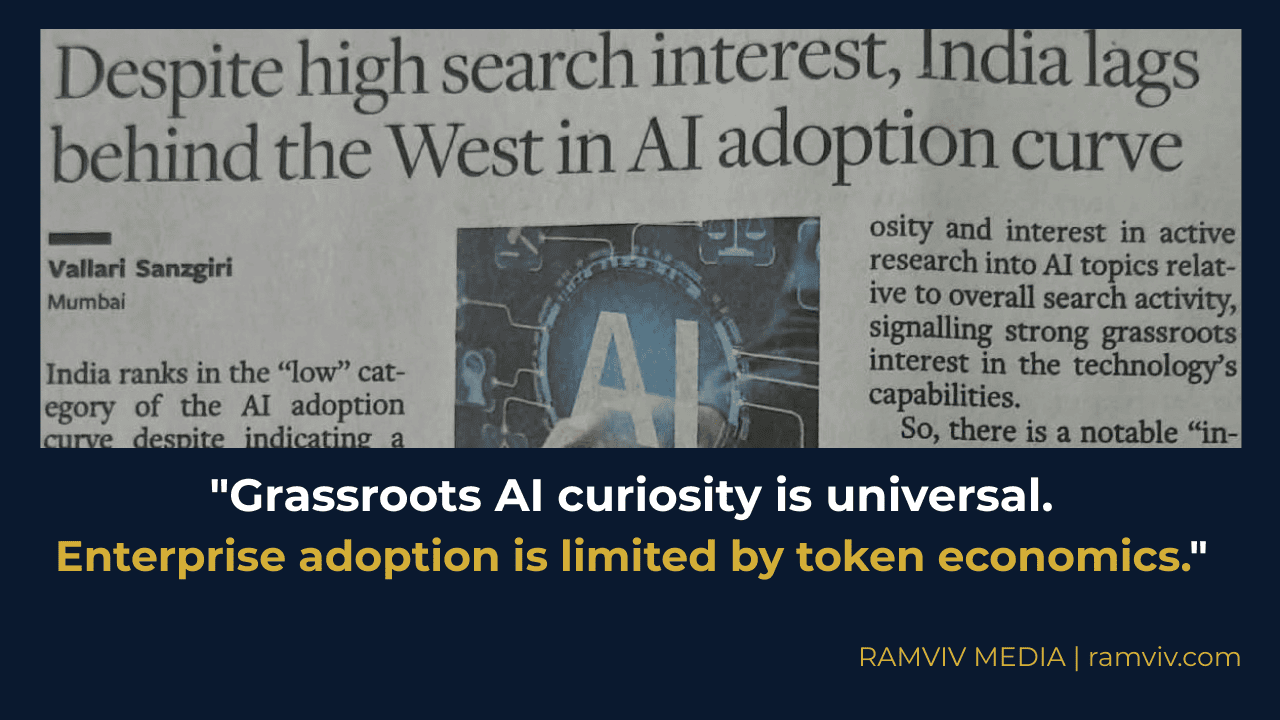
Across global technology discourse, artificial intelligence is frequently described as a borderless equalizer. In practice, recent empirical data illustrates an expanding divide between digital curiosity and commercial deployment.
A study analyzing global Google AI usage data highlighted in *The Hindu BusinessLine* underscores a stark divergence: while emerging markets across South Asia demonstrate the highest share of proactive search queries regarding artificial intelligence, they remain categorized in the lower tiers of real-world, per-capita conversational AI usage.
In mature Western economies, conversational models have quietly migrated from novel search queries into background utilities deeply embedded within corporate productivity stacks. In contrast, developing markets remain hindered by an “interest-adoption gap” driven not by user reluctance, but by structural compute economics.
1. Deconstructing the Interest-Adoption Gap
Historically, technology adoption correlates with national wealth; per-capita AI usage displays a 0.9% rise for every 1% increase in GDP per capita. Consequently, the lowest-adopting tier of nations accounts for just 2% of global conversational AI interactions, despite housing a substantial proportion of global STEM graduates and active digital searchers.
The friction preventing grassroots curiosity from maturing into enterprise workflow adoption centers on three primary factors:
- Infrastructure and Connectivity Limits
Deploying low-latency intelligence requires distributed edge compute and stable bandwidth that remains unevenly distributed across secondary and tertiary geographies.
- High Cost-to-Value Disparity
When AI tools are priced in US dollars on flat subscription tiers ($20/seat/month), they represent a negligible expense for a Silicon Valley knowledge worker, but an unsustainable cost center for distributed offshore operations and emerging-market enterprises.
- Structural Tokenization Inefficiency
The most critical technical barrier lies in the mathematical architecture of modern Large Language Models: tokenizer design.
2. The Mechanics of Tokenization Bias
LLM tokenizers (such as Byte-Pair Encoding) were predominantly trained on massive corpuses of English and Latin-character text. As a consequence, English words typically map efficiently to single tokens (or fractions of tokens).
For non-Latin scripts (including Devanagari, Tamil, Bengali, Arabic, and Cyrillic), tokenizers routinely break standard words into multiple byte fragments.
This creates severe operational penalties:
Multiplied Compute Invoices: Because API providers bill per 1,000 input/output tokens, processing identical semantic intent in Hindi or Tamil can consume 3x to 6x the token count of an equivalent English query, directly multiplying operational inference costs.
Latency Inflation:Generating responses requires sequential decoding over dramatically larger token counts, increasing latency and compromising real-time transactional reliability.
Context Window Degradation: Effective context capacity in RAG (Retrieval-Augmented Generation) systems is artificially shrunk when vernacular data fills token buffers prematurely.
3. The Path Forward: From Curiosity to Sustainable Utility
Closing the interest-adoption gap will not be achieved by merely translating user interfaces or offering localized marketing campaigns. It requires fundamental engineering shifts:
- Native Vernacular Tokenizers: Training foundation models and fine-tuned domain variants with balanced vocabularies that treat non-Latin characters with equal bit-level efficiency.
- Lightweight Edge Architectures: Moving routine queries away from centralized frontier cloud models and onto small, specialized language models (SLMs) running locally.
- High-Intent B2B Alignment:Transitioning away from open-ended chatbots toward deterministic, outcome-driven workflows that deliver immediate, measurable ROI on balance sheets.
The next phase of global software leadership belongs to teams that engineer around token efficiency and workflow integration, transforming global curiosity into sustained commercial momentum.
Build High-Efficiency Digital Architecture for Global Scale
At Ramviv Digital Media, we analyze enterprise AI economics, generative search discovery, and high-converting B2B content syndication to help technology platforms scale efficiently.