For nearly three decades, the global technology services and software industry scaled along a single, predictable axis: billable headcount.
If an enterprise client needed to build an application, modernize legacy infrastructure, or manage back-office processes, technology providers deployed large squads of engineers and support analysts. Margins were protected through labor arbitrage, and market capitalization followed employee numbers.
That paradigm has officially hit an evolutionary wall.
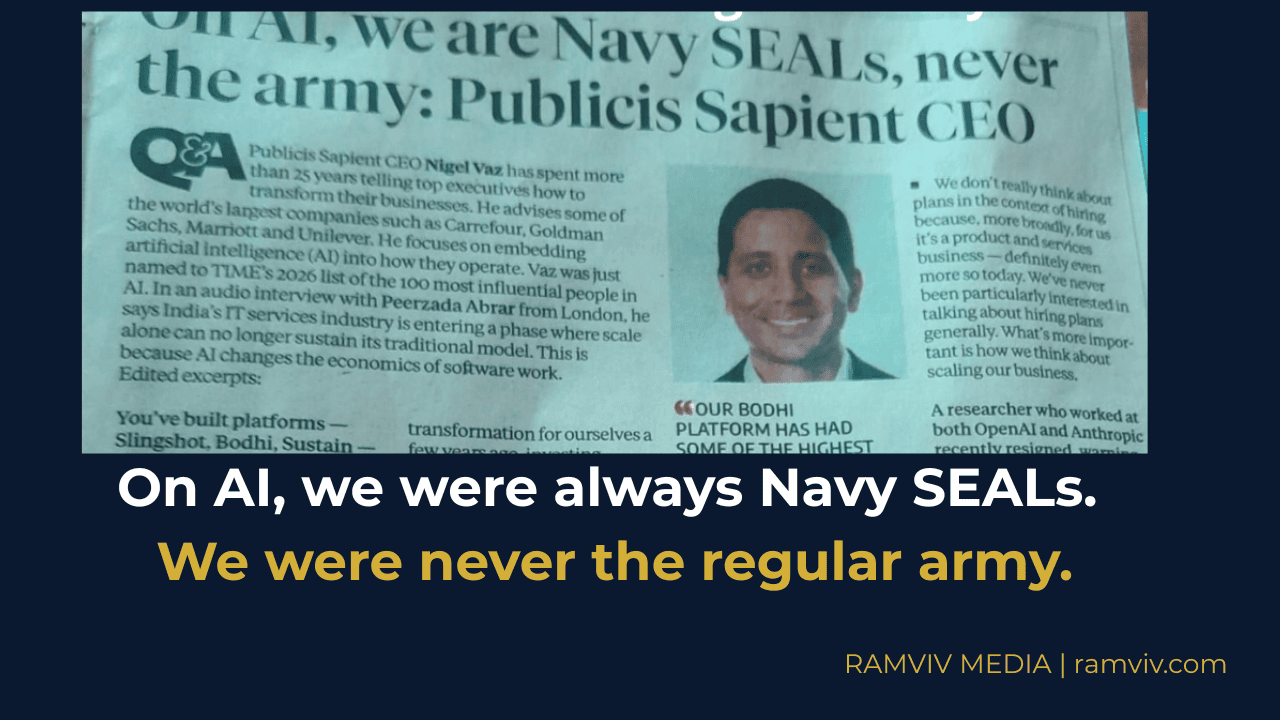
In an interview with *Business Standard*, Nigel Vaz, CEO of Publicis Sapient, captured this structural shift with absolute precision: On AI, we were always Navy SEALs. We were never the regular army; so we didn’t have hundreds and hundreds of thousands of people.”
As artificial intelligence alters the fundamental economics of software, digital production, and customer workflows, the competitive moat is shifting from labor volume to high-leverage execution.
1. The Breakdown of the Commoditized Services Model
The traditional managed services model relied heavily on low-cost teams performing predictable, repetitive tasks: triage tickets, basic quality assurance, repetitive coding patterns, and administrative data transfers.
Today, agentic AI systems and automated workflows can execute those exact tasks in seconds at near-zero marginal cost.
When incident triage, error log resolution, and basic software deployment are managed natively by intelligent platforms, hiring hundreds of entry-level workers to manage a ticket queue becomes a liability rather than an asset. Enterprises no longer want to pay for billed hours—they are demanding specialized domain expertise and direct commercial outcomes.
2. Escaping the Enterprise “Pilot Purgatory”
Most global enterprises have experimented with generative AI over the past two years, yet a vast majority remain trapped in experimental pilot phases.
The primary bottleneck is not model capability; it is process redesign.
As Vaz highlighted, true AI-native transformation requires tearing down legacy friction. In one financial services deployment, a traditional 70-step customer onboarding pipeline was reduced to a fraction of that journey by utilizing autonomous agents that hand off only critical edge cases for human-in-the-loop validation.
Transformative gains do not come from bolting an AI chatbot onto an outdated, 50-step bureaucracy. They come from eliminating unnecessary steps entirely.
3. The Economics of Model Routing
A critical operational challenge facing enterprise tech leaders is runaway infrastructure expenditure. B2B software architectures that rely naively on a single frontier model face severe cost inefficiencies.
Enterprise-grade architectures now deploy dynamic model orchestration hubs:
Frontier Reasoning Models: Reserved strictly for complex cognitive challenges, system architectural decisions, and deep logical analysis.
Specialized Lightweight Models:Deployed for high-frequency, low-latency tasks (basic parsing, routine queries, structured categorization) at a tenth of the compute cost.
Locking an organization into a single proprietary model limits capability and inflates unit economics. Modern digital infrastructure must dynamically allocate compute resources based on real-time task complexity.
What This Means for B2B Growth & Publishing Leaders
The transition from a “regular army” to an elite “Navy SEAL” unit mirrors what is occurring across digital publishing, content syndication, and B2B customer acquisition.
Generating massive volumes of low-value, generic content no longer drives enterprise pipeline. Instead, companies require targeted, high-authority publishing assets that address complex commercial search queries and command authority inside both human search and generative engine answers.
Agility, high-intent targeting, and senior operator execution have replaced brute-force volume.
Build High-Authority B2B Visibility Without the Overhead
At Ramviv Digital Media, we operate as an agile media partner for tech brands—publishing data-backed content assets and managing high-intent search traffic acquisition.